
Introduction
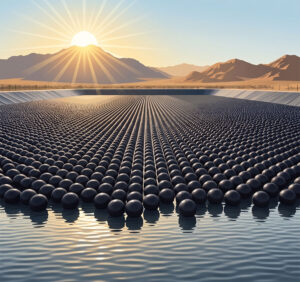
In large-scale water management, material selection is not just a technical detail, it is the foundation of long-term project performance. Floating shade balls are widely used in:
- Municipal drinking water reservoirs
- Agricultural irrigation ponds
- Industrial storage tanks
- Wastewater treatment facilities
By covering the liquid surface, they help reduce evaporation, block sunlight, and limit algae growth.
However, several practical questions often arise:
- Will plastic balls affect water quality?
- How can they remain effective for over 10 years outdoors?
- Why are they typically black?
- Can they perform in wastewater or chemically active environments?
The answers to these questions are closely related to the material used to manufacture them.
Most high-quality shade balls are made from HDPE (High-Density Polyethylene), a material widely used in both water-related and industrial systems. Understanding the properties of this material helps explain how floating shade balls work in demanding, real-world environments.
1. Understanding HDPE: The Engineering Foundation
High-Density Polyethylene (HDPE) is a thermoplastic polymer known for its high strength-to-density ratio.
Key structural characteristics include:
- A relatively linear molecular structure
- High tensile strength
- Good impact resistance
Because of these properties, HDPE is widely used in:
- Water pipelines
- Chemical storage containers
- Industrial infrastructure components
This track record demonstrates its ability to maintain structural integrity under continuous liquid contact and mechanical stress.
2. Suitability for Water Contact
For reservoir management and public water systems, one key concern is whether materials may influence water quality.
HDPE is commonly used in these environments due to its stability:
- Chemically low-reactive under normal conditions
- Does not rely on plasticizers such as BPA
- Shows low levels of substance migration in typical applications
As a result, it is widely applied in systems involving long-term water contact.
This highlights why selecting the right formulation and maintaining strict manufacturing quality are essential for long-term reliability.
3. Performance in Wastewater and Industrial Environments
In addition to clean water systems, shade balls are often used in wastewater treatment and industrial applications.
These environments may involve exposure to various substances. HDPE performs well due to its chemical resistance.
Typical conditions include:
- Acids and alkalis → stable across a wide pH range
- Salts and dissolved solids → resistant to corrosion effects
- General industrial water → suitable for non-aggressive to moderately reactive environments
Because of this, HDPE is widely used in:
- Wastewater treatment ponds
- Industrial storage tanks
- Chemical handling systems
4. Why HDPE Performs Well Outdoors
Shade balls must operate continuously in outdoor environments. HDPE supports this through several key properties.
UV Stability and Lifespan
Exposure to sunlight is a major cause of polymer degradation. To address this, HDPE used in shade balls is typically combined with stabilizing additives.
- Helps absorb and dissipate UV radiation
- Reduces long-term material degradation
- Supports a service life of 10+ years in outdoor conditions
This durability is an important factor in long-term project planning.
Precision Buoyancy
HDPE has a density of approximately 0.94–0.97 g/cm³, which allows it to float naturally.
- Maintains stable positioning on water surfaces
- Can be partially filled for ballast
- Helps resist displacement from wind and waves
Impact and Mechanical Strength
Water surfaces can be dynamic, especially in outdoor conditions.
HDPE provides:
- Good impact resistance
- Reduced risk of cracking
- Structural stability during movement and collision
5. Why Are Shade Balls Black?
The black color of shade balls is a functional design choice rather than a visual one.
During manufacturing, carbon black is added to the HDPE material. This provides several benefits:
- Enhances UV resistance
- Protects the polymer structure from sunlight
- Reduces light penetration into water
By limiting light entry, shade balls help reduce algae growth and improve overall water management efficiency.
6. Is Carbon Black Safe?
Carbon black is a carbon-based additive widely used in plastics and industrial materials.
In shade balls:
- It is embedded within the HDPE matrix
- It does not exist as a loose or surface coating
Under normal usage conditions:
- This structure limits direct interaction with water
- Helps maintain long-term material stability
As with other material components, its behavior depends on formulation, processing quality, and application conditions.
7. HDPE vs. Alternative Materials
Other plastics such as polypropylene (PP) may be used in similar applications, but HDPE is often preferred for outdoor floating systems.
Compared with alternatives, HDPE offers:
- Better resistance to environmental stress
- More stable performance under UV exposure
- Stronger chemical resistance in water environments
For long-term projects, this balance of properties contributes to lower maintenance and replacement frequency.
8. Applications of HDPE Shade Balls
Due to its durability and stability, HDPE is widely used in shade ball applications such as:
- Drinking water reservoirs
- Irrigation ponds
- Wastewater treatment systems
- Industrial liquid storage
Beyond material safety, these floating systems are also a primary solution used to reduce water evaporation in open water surfaces, providing a highly effective and maintenance-free way to conserve water resources in arid regions or high-heat environments.
Conclusion
The effectiveness of shade balls is closely linked to the material properties of HDPE. Its combination of durability, chemical stability, and adaptability allows it to perform reliably across a wide range of water environments.
From drinking water systems to industrial wastewater applications, HDPE provides a balanced solution for long-term floating cover systems.
Understanding the material behind shade balls helps explain not only how they function, but also why they remain effective over extended periods of use.
-拷贝-300x300.jpg)