Introduction
Reducing water evaporation is a major challenge in large-scale systems such as agricultural reservoirs, industrial ponds, and water treatment facilities. If you are exploring how to reduce water evaporation effectively, it is essential to understand how different solutions perform under real-world conditions.
Environmental factors such as wind, sunlight, and surface area significantly impact evaporation rates. Therefore, selecting the right evaporation control method is not only about initial cost, but also about long-term performance, durability, and operational efficiency.
Factors That Affect Water Evaporation
Water evaporation is influenced by several key factors:
- Temperature
- Wind exposure
- Sunlight (UV radiation)
- Surface area
In large outdoor reservoirs, wind and sunlight are often the dominant drivers. Any effective solution must perform reliably under these conditions.
Categories of Water Evaporation Control Methods
Evaporation control solutions can generally be grouped into:
- Chemical evaporation suppressants
- Floating cover systems (blankets and membranes)
- Physical barriers (windbreaks and shade structures)
- Reflective dyes
- Modular floating systems (floating balls and interlocking modules)
Each category offers a different balance between cost, complexity, and long-term effectiveness.
Comparison of Water Evaporation Solutions
| Solution | Suitable Scale | Installation | Maintenance | Flexibility | Typical Use |
| Chemical Methods | Small–Medium | Easy | High | High | Temporary use, calm water conditions |
| Floating Covers | Medium–Large | Complex | Medium | Low | Controlled reservoirs, regular-shaped systems |
| Physical Barriers | Medium | Medium | Low | Medium | Wind reduction, supplementary protection |
| Reflective Dyes | Small–Medium | Easy | High | Medium | Small reservoirs, decorative ponds, supplementary method |
| Modular System | Large | Easy | Low | High | Large reservoirs, industrial ponds, water treatment |
1. Chemical Evaporation Suppressants
Chemical evaporation suppressants are surface treatment solutions that form a thin monomolecular film on the water surface to reduce evaporation. These compounds are typically based on long-chain fatty alcohols and are applied in liquid form, spreading naturally across the surface to create a temporary barrier.
By reducing the rate at which water molecules escape into the air, these films can lower evaporation under controlled conditions.
Pros:
- Easy to apply
- Low initial cost
- No physical installation required
Cons:
- Extremely sensitive to wind and surface disturbance
- Film can break or disperse in open environments
- Requires frequent reapplication, increasing operational costs (OPEX)
- Performance is difficult to maintain consistently over large areas
Best suited for small or controlled environments, but generally not effective for large-scale outdoor reservoirs.
2. Floating Cover Systems (Blankets / Membranes)
Floating cover systems are evaporation control solutions that use continuous sheets or membranes to physically cover the water surface. These covers are typically made from flexible materials such as reinforced plastic films or geomembranes, and are designed to float on the water to form a near-complete barrier between the liquid and the surrounding environment.
By isolating the water surface from direct exposure to air, sunlight, and wind, these systems can significantly reduce evaporation and heat transfer.
Pros:
- High surface coverage
- Strong evaporation reduction performance
Cons:
- Complex installation for large-scale projects
- Difficult to adapt to irregular shapes
- Affected by water level fluctuations
- May restrict gas exchange, impacting water quality
Suitable for controlled or medium-scale systems, but less practical for large open reservoirs.
3. Physical Barriers (Windbreaks & Shade Structures)
Physical barrier systems are designed to reduce evaporation by modifying the surrounding environment rather than directly covering the water surface. These typically include windbreaks (such as fences or vegetation) and shade structures (such as nets or canopies) installed around or above the reservoir.
Pros:
- Reduces surface wind speed effectively
- Can partially limit solar radiation
- Low maintenance for natural windbreaks (e.g., trees)
Cons:
- Do not directly cover the water surface
- Shade nets are vulnerable to storm damage and UV degradation
- Planting trees requires significant land area around the reservoir
Best suited for small-scale agricultural ponds or used as a supplementary measure alongside primary evaporation control systems.
4. Reflective Dyes
Reflective dyes are surface treatment solutions added to water to increase its reflectivity (albedo), reducing solar heat absorption and slowing down evaporation. These additives are typically applied in liquid or powder form and disperse across the water surface.
Pros:
- Easy to apply
- Can reduce solar heat absorption
- May help lower overall water temperature
Cons:
- Limited effectiveness in large-scale outdoor systems
- Performance can be affected by wind and water movement
- Requires repeated application over time
- Not widely adopted in industrial applications
Typically used as a niche or supplementary method rather than a primary evaporation control solution.
5. Modular Floating Systems (Floating Balls vs Interlocking Modules)
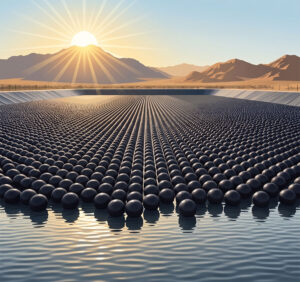
Modular floating systems are evaporation control solutions that use individual floating elements to form a protective layer across the water surface. Unlike continuous covers, these systems consist of discrete units that can move and adjust freely.
Common designs include:
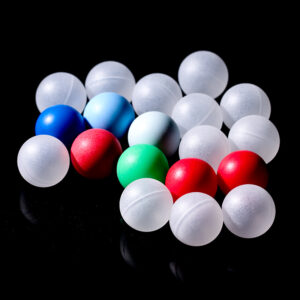
- Spherical elements (shade balls)
- Interlocking modules (hexagonal or square floating units)
Compared to continuous floating covers, modular systems are easier to deploy and more adaptable to irregular water bodies and fluctuating water levels.
Common Advantages of Modular Systems
- No complex installation required
- Automatically adapt to changing water levels
- Suitable for large-scale applications
- Allow partial gas exchange, helping maintain water quality
- Lower maintenance compared to continuous cover systems
Floating Modules vs Shade Balls
While both designs belong to modular floating systems, their structural differences lead to distinct performance characteristics.
Interlocking modules typically require alignment or connection between units to form a stable surface. This can make installation more time-consuming and may limit flexibility when dealing with irregular reservoir shapes or changing water levels.
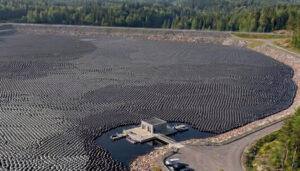
In contrast, spherical shade balls are free-moving and do not require any fixed arrangement. They naturally distribute themselves across the water surface, maintaining consistent coverage without manual adjustment.
Under outdoor conditions, especially in large open reservoirs, wind exposure becomes a critical factor. Flat or connected modules may shift, misalign, or require repositioning, while spherical designs tend to remain stable by continuously adjusting their position.
Why Shade Balls Are Preferred for Large-Scale Applications
For large-scale applications, simplicity, adaptability, and long-term stability are key considerations.
Spherical shade balls offer several practical advantages:
- Self-adjusting behavior, maintaining consistent coverage
- Strong adaptability to irregular shapes and fluctuating water levels
- No installation complexity, simply deploy across the surface
- More stable performance under wind exposure
- Minimal maintenance after deployment
In addition, material selection plays a critical role in long-term performance.
Shade balls are typically manufactured from high-density polyethylene (HDPE) with added carbon black or UV stabilizers. This combination provides strong resistance to ultraviolet degradation, chemical exposure, and environmental stress, allowing the product to maintain structural integrity over many years of outdoor use.
This is also why most shade balls are black in color, as carbon black significantly enhances UV resistance and durability.
How to Choose the Right Solution
The best solution depends on your specific scenario:
- Small or controlled systems → simple methods may suffice
- Medium-scale systems → continuous covers can be effective
- Large-scale outdoor reservoirs → require adaptability, durability, and low maintenance
In these conditions, modular floating systems, especially shade balls, are often the most practical choice.
Read more detailed explanation of how shade balls work and where they are used.
Key Takeaways
- No single method fits all applications
- Wind and UV exposure are critical factors
- Continuous covers offer strong performance but limited flexibility
- Chemical and dye-based solutions require ongoing maintenance
- Modular systems provide the best balance for large-scale applications
- Among them, shade balls stand out for simplicity, adaptability, and reliability
Conclusion
Choosing the right evaporation control method requires balancing performance, cost, and operational practicality.
For large-scale applications such as agricultural reservoirs, industrial ponds, and water treatment systems, flexibility and long-term stability are critical.
Among all available solutions, modular floating systems offer a strong balance of performance and efficiency. Within this category, shade balls provide a particularly practical and scalable approach for real-world conditions.