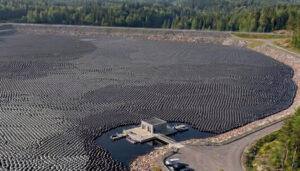
You may have seen images of millions of black plastic balls covering massive water surfaces. Originally popularized by major municipal projects in California, these engineered spheres are now a global standard for protecting critical water resources, agricultural irrigation, and industrial wastewater ponds.
For engineers and project buyers, understanding the financial feasibility is the first step. How much do shade balls cost? Instead of looking at misleading retail prices, we must analyze historical project data and the technical variables, including manufacturing specifications and bulky freight logistics, that drive large-scale budgeting.
Key Takeaways: Cost Components You Must Consider
When budgeting for a shade ball project, your final “landed cost” is determined by three main factors:
-
The Product Benchmark: Historically, major US municipal projects have established an industry benchmark of approximately $0.36 per unit. Partnering directly with an experienced manufacturer can significantly optimize this baseline cost, offsetting the rising costs of domestic manufacturing.
-
The Logistics Impact (Freight): Shade balls are high-volume, lightweight items. Ocean freight and inland transportation will make up a notable percentage of your total budget.
-
Minimal Installation Costs: Unlike permanent physical covers, shade balls require no specialized infrastructure or heavy machinery, dramatically reducing the required labor investment.
Analyzing Historical Project Costs
To estimate the price of shade balls, we can look at publicly available data from the world’s most significant deployments. These major projects typically utilize the industry standard 100mm (4-inch) diameter spheres:
-
The Los Angeles Reservoir: This project utilized approximately 96 million standard 100mm shade balls with a total budget of $34.5 million. This historic benchmark demonstrates that even with a multi-million dollar investment, the shade ball solution was hundreds of millions of dollars cheaper than constructing a permanent physical cover.
-
Las Virgenes Reservoir (Calabasas): A mid-scale project utilizing roughly 1 million 100mm shade balls. This demonstrates that the technology is a viable, highly scalable option for mid-sized industrial facilities, municipal reserves, and agricultural ponds without needing a mega-project budget.
Why Do “Factory-Direct” Prices Vary?
As a specialized shade balls manufacturer, we emphasize that a precise quote is influenced by your specific site conditions and engineering requirements. Instead of focusing on the lowest unit price, most large-scale projects evaluate shade ball cost based on durability, UV resistance, and total lifecycle performance, which can significantly impact the overall investment.
-
Material Purity (Virgin HDPE): We prioritize 100% virgin-grade HDPE and strictly prohibit post-consumer recycled (PCR) waste. High-purity resin ensures a stable environment that will not leach unverified chemicals into your water reserve.
-
Weight and Wall Thickness: The unit cost is directly tied to the gram weight of the sphere. While standard specifications suffice for many projects, environments with higher structural demands may require thicker-walled spheres for added durability.
-
UV Resistance & Lifecycle: For regions with intense sunlight, specialized Carbon Black is essential. Engineering balls to withstand long-term UV exposure requires a premium, stabilized chemical balance to prevent degradation.
The Elephant in the Room: Global Logistics Costs
Because shade balls are lightweight but voluminous, ocean freight is a major component of your final landed cost. The shipping cost is not calculated by weight, but by container space.
How many shade balls fit in a shipping container? Based on our industrial export standards, a single 40HQ high-cube container typically accommodates approximately 70,000+ pieces of 100mm spheres.
If your project requires 1 million spheres, you are looking at coordinating over 14 containers. Therefore, the overall shade balls cost fluctuates based on real-time ocean freight rates to your destination port. This is exactly why a static online price is never accurate for professional B2B buyers.
The Hidden ROI: Minimal Installation Requirements
The true value of this technology becomes clear when you evaluate the cost to install shade balls. Traditional covers require structural engineering, labor-intensive mounting, and often require the reservoir to be drained.
Shade balls are designed for rapid deployment. They are simply poured onto the water surface, where they automatically spread to cover 91% of the area. While this requires basic labor to manage the delivery and release, it eliminates the need for expensive specialized contractors and heavy equipment, allowing projects to pay for themselves rapidly through saved water and reduced chemical use.
Frequently Asked Questions (FAQ)
Q: Are shade balls only used to prevent water evaporation?
A: While reducing evaporation by up to 90% is a primary financial benefit, they deliver exceptional ROI across several industrial applications:
-
Algae Suppression: By blocking sunlight, the spheres halt photosynthesis, reducing the need for expensive chemical treatments.
-
VOC and Odor Control: The balls form a physical barrier that minimizes the emission of hazardous odors and Volatile Organic Compounds (VOCs).
-
Heat Reduction: The spheres act as a thermal insulator, maintaining more stable water temperatures in harsh climates.
Q: How much did the LA reservoir shade balls cost?
A: Public records indicate a total cost of $34.5 million for 96 million balls. This established a historic benchmark of approximately $0.36 per ball, providing a reference point for large-scale municipal budgeting.
Q: How do I calculate the total number of shade balls needed for my reservoir?
A: The industry-standard coverage calculation is straightforward: for 100mm black shade balls, you will need approximately 10.7 balls per square foot, which translates to roughly 116 balls per square meter. Once you determine your total required quantity based on surface area, explore our customization capabilities or contact our engineering team for an accurate estimate on both product and global freight costs.
Q: What is the cost of shade balls for a mid-sized industrial pond?
A: Wholesale pricing depends entirely on the total volume and specific resin requirements. While retail prices remain high, factory-direct quotes for industrial-grade bulk orders (starting at 100,000+ units) provide massive economies of scale, making million-ball deployments highly cost-effective for B2B buyers.
Get a Precision Quote for Your 2026 Project
As a professional manufacturer, we do not provide a one-size-fits-all price list. We provide engineered solutions and transparent logistics.
To receive an accurate quote, including manufacturing specifications and real-time freight calculations to your destination port, please provide us with your reservoir dimensions (Square Feet / Square Meters) and your project timeline.
-拷贝-300x300.jpg)