Introduction
Choosing the right plastic material is a critical step in packaging design. Different materials offer varying levels of strength, chemical resistance, transparency, and processing stability.
From cosmetic packaging and personal care products to food containers and industrial applications, the material you select directly impacts product performance, safety, and cost efficiency.
This guide provides a practical comparison of common plastic materials and explains how to choose the right one based on real-world applications and manufacturing considerations.
Overview of Common Plastic Materials
The following comparison focuses on widely used plastics in packaging, especially in personal care, cosmetics, food, and industrial applications.
Below is a quick comparison of the most commonly used plastic materials in packaging, including their key properties and typical applications.
| Material | Clarity | Rigidity | Chemical Resistance | Processing Stability | Typical Use |
| PP | Translucent | High | Excellent | Stable, low shrink variation | Caps, roll-on balls |
| LDPE | Opaque | Low | Excellent | Flexible, easy processing | Squeeze bottles, tubes |
| HDPE | Opaque | High | Excellent | Higher shrinkage, less uniform | Industrial containers |
| PET | High clarity | Medium | Good | Stable for blow molding | Beverage bottles |
| PETG | High clarity | Medium | Good | Easy processing, good toughness | Cosmetic bottles |
| PS | Clear | Low | Moderate | Brittle, easy to mold | Disposable packaging |
| ABS | Opaque | High | Moderate | Good dimensional stability | Structural parts |
Each material offers a different balance between performance, appearance, and cost, making it suitable for specific applications.
Packaging Levels and Material Selection
In most industries, packaging can be divided into three levels:
-
Primary packaging: Direct contact with the product (e.g., bottles, roll-on components)
-
Secondary packaging: Outer layer for branding and protection
-
Tertiary packaging: Used for transportation and bulk handling
Material selection is especially critical for primary packaging, where safety, chemical compatibility, and user experience must be carefully considered. For most buyers, the key focus is primary packaging, as it directly affects product safety, compatibility, and user experience.
How to Choose the Right Plastic Material
Selecting the right material requires balancing performance, safety, appearance, and manufacturability.
Mechanical & Processing Performance
Material behavior during manufacturing is crucial, especially for precision components.
PP vs HDPE: Shrinkage and Dimensional Stability
While both PP and HDPE are widely used in plastic products, they behave differently during injection molding.
HDPE typically has a higher and less uniform shrinkage rate due to its higher crystallinity. This can lead to:
-
Warpage
-
Sink marks
-
Dimensional variation
These issues may increase defect rates and production costs, especially for high-precision components. In contrast, PP provides more predictable shrinkage and better dimensional stability, making it easier to control in precision applications.
For this reason:
-
PP is preferred for high-precision components
-
HDPE is more suitable for industrial and large-scale applications
Chemical Resistance & Safety
Material stability is essential for applications involving direct product contact.
-
PP and PE (LDPE / HDPE) offer excellent resistance to moisture and a wide range of chemicals
-
HDPE performs well in harsh industrial environments
-
PET and PETG are suitable for applications requiring clarity and moderate chemical resistance
For regulated industries such as personal care, cosmetics, and pharmaceuticals, material compatibility and safety compliance are critical factors.
Transparency & Appearance
In consumer-facing products, visual appeal plays a key role.
-
PET and PETG provide high transparency and a premium look
-
PP and PE are typically opaque and more functional
-
PS offers clarity but is more brittle and less durable
Material Applications in Different Industries
Different industries prioritize different material properties based on performance requirements and user expectations.
Personal Care Products
Daily-use products such as deodorants, antiperspirants, and body care solutions require materials that ensure consistent performance and user comfort.
PP is widely used due to its balanced mechanical properties and smooth surface characteristics.
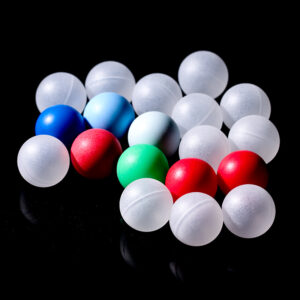
For example, precision-molded PP roll-on balls are commonly used in deodorant packaging, allowing smooth application while maintaining reliable sealing performance.
LDPE and HDPE are often used for bottle bodies due to their flexibility and durability.
Cosmetic Packaging
Cosmetic packaging requires a balance between aesthetics and functionality.
-
PETG is widely used for transparent bottles, offering clarity and impact resistance
-
PP is commonly used for caps and internal components due to its durability and chemical resistance
Food & Beverage Packaging
Safety and compliance are key requirements in this sector.
-
PET is commonly used for beverage bottles due to its transparency and strength
-
LDPE is widely used for squeeze bottles and flexible packaging
Industrial Applications
Industrial environments require materials that can withstand chemicals, UV exposure, and long-term use.
-
HDPE is widely used for industrial containers and outdoor applications
For example, HDPE hollow balls are commonly used in water treatment systems and reservoirs due to their durability, chemical resistance, and long service life.
Why PP is Ideal for Precision Components
For applications that require high precision and consistent performance, PP is one of the most reliable materials.
Key advantages include:
-
Low friction for smooth movement
-
High fatigue resistance for repeated use
-
Stable shrinkage for precision molding
-
Good chemical compatibility
These properties make PP especially suitable for components that require tight tolerances and repeated mechanical interaction, such as roll-on balls and dispensing systems.
Sustainability & Recyclability
Sustainability is becoming increasingly important in packaging design.
Many commonly used plastics are recyclable and widely accepted in global recycling systems:
-
PP (Code 5)
-
HDPE (Code 2)
-
LDPE (Code 4)
-
PET (Code 1)
The future of packaging materials is moving toward a balance between performance, sustainability, and cost efficiency.
Conclusion
There is no single “best” plastic material for packaging.
Each material offers a unique combination of:
-
Mechanical performance
-
Chemical resistance
-
Processing behavior
-
Cost efficiency
Understanding how these materials behave in real-world applications—especially during manufacturing—helps businesses make more informed and competitive decisions.